



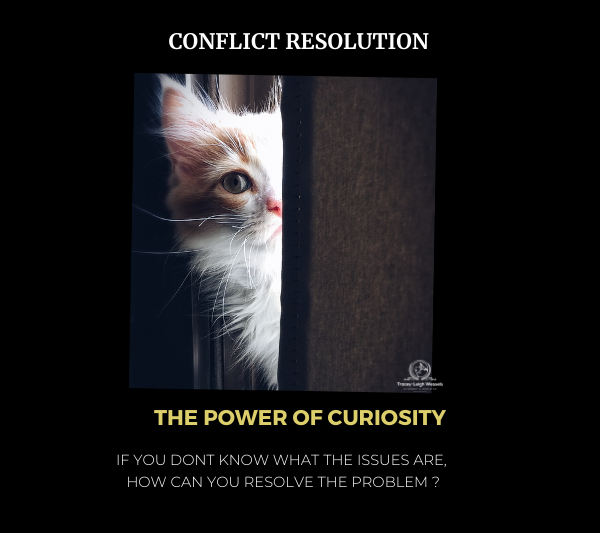
How do you generally respond to conflict? Do you become defensive and attack? Withdraw and become bitter? Do you Charge, Shout, Scream? or, Do you become Silently Hostile, Passively-Aggressive, Opinionated & Argumentative ?
Next time you are in a conflict situation, Pause and as Mel Robbins famously reminds us count “5. 4. 3. 2.1.” and allow yourself to become curious about what is happening in the heart and mind of the other person. Curiosity is a natural phenomenon for humans, we are born with it, but somewhere along the way, we lose it and lose out on understanding the “why” behind the sudden deterioration of a relationship into a new state of extreme hostility and antagonism. Very often, the hostility we see is only the visible surface of a much deeper set of fears, needs, and concerns beneath the dispute — what mediators often describe as the conflict iceberg.
The Power of Curiosity prompts a person to ask difficult questions but usually with the right tone of voice and heart – one that conveys a general desire to understand what is going on and why the situation is unfolding as it is. It is curiosity that is motivated more by the desire to understand someone else than to be fully understood. Curiosity helps us shift from defending our own position to trying to see the situation through the eyes of the other person, which is often the first step in being able to change your perspective.
Authentic Curiosity that prioritizes trying to understand another person’s “why” and their motivation for the things they do and say, is a priceless commodity where relationship peace is at stake.
In a nutshell, when faced with a conflict situation:
- Stop – do not respond with the first thing that comes to mind.
- Breathe & Allow Your Mind to Pause – 5.4.3.2.1.
- Do not react impulsively or in anger.
- Ask Yourself: What is Happening Here ? Why Do I think that this person has just reacted this way?
- Ask the other person, “What is happening right now? Please help me to understand why you are reacting the way that you are”
- Listen to the answers to these questions.
- Keep on asking questions until you fully understand the other person’s position.